
By: Nick LaPorte, 6/20/2019
When someone asks you, “Who is the best player in baseball?” there is only one acceptable answer.
Mike Trout.
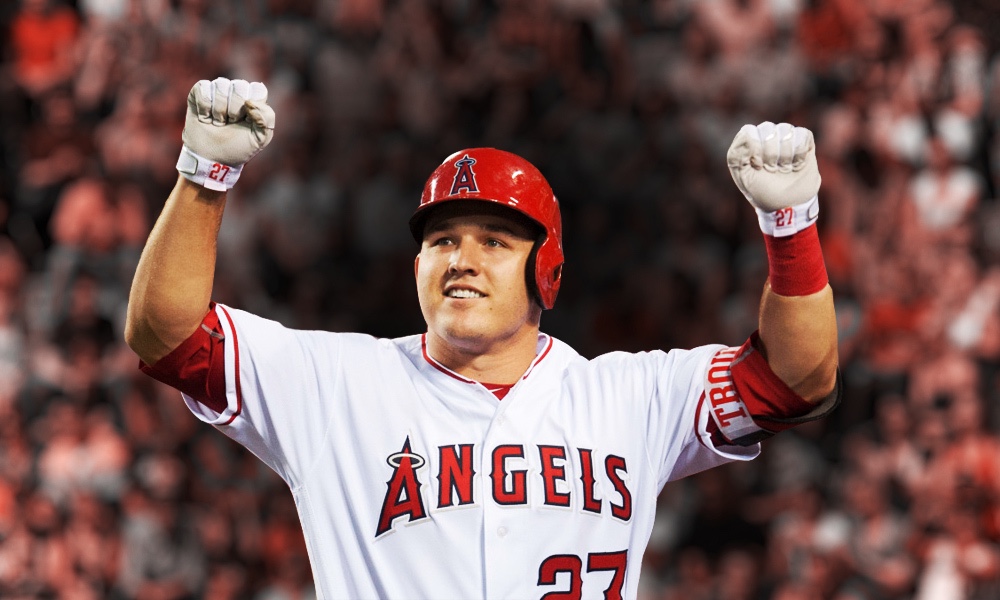
This has been true since Trout’s rookie year in 2012. He has been awarded 2 AL MVPs, in 2014 and 2016. The big argument against Trout in his first two seasons was that he didn’t make the playoffs. How good could he really be if he couldn’t drag his team to postseason baseball?
Well, Trout finally reached the playoffs in 2014, leading the Angels to 98 wins and the top overall seed in the AL. That season, funnily enough, was the worst of Trout’s three seasons. After accumulating seasons of 10.1 and 10.2 WAR, he dropped to 8.3, which as of last season, is Trout’s worst statistical year. Trout’s Angels were swept out of the playoffs by the eventual AL Champion Royals, and Trout notched only 1 playoff hit, a solo home run.
To date, that is Trout’s only postseason hit. In the 4 years since, he has yet to sniff another plate appearance in October baseball. To be fair to the voters, they decided to overlook this lack of playoff resume in 2016, awarding Trout his 2nd MVP even though the Angels did not contend for a playoff spot.
I understand the thinking, I truly do, that a player shouldn’t be the “best player” if he can’t get his team to 90+ wins. In a vacuum it makes sense. There have been seasons in which there were cases to be made against Trout. In 2018, for example, Mookie Betts of the Red Sox surpassed Trout’s WAR. Jose Altuve of the Astros had the narrative in 2017. Miguel Cabrera won the Triple Crown in Detroit in 2012, and led Detroit back to the playoffs in 2013. Even Josh Donaldson’s 2015 in Toronto was somewhat arguable, as Donaldson drove in 20 more runs. By the way, I did not fault voters in 2018 when they picked Mookie Betts of the Red Sox, who actually led all of baseball in WAR last year. Consider, however, that the best player in baseball only has 2 MVP awards in his first 7 seasons. Trout should realistically have at least 5 MVP awards, however as I mentioned, you can explain the reasoning in some of the previous seasons.
The thing about Trout is that while one player can match him for a season, no one can match him year in and year out. Trout’s ability to obtain >9 WAR, hit .300 with 35 homers and 100 RBIs, all while playing good defense in CF, running the bases better than anybody, and affecting the game in every facet, makes him the presumptive favorite year in and year out. Trout, in fact, has never had a healthy season lower than 8 WAR. That mark is almost mythical; it’s the kind of consistent production every player dreams of. If Trout keeps up this pace, he has a chance to become the all-time leader in WAR. At this pace, he very well may finish top-25 ever. There are 4,029 recorded players on the WAR leaderboard. The fact that Trout may finish in the 99th percentile of all players in recorded history is something to marvel at. The very best player of all time might be playing center field for the Angels right now.
Back to the topic at hand.
As for this year’s MVP award, it is a runaway for Trout so far. He is sitting at 4.8 WAR, which only trails Cody Bellinger in the NL. The next closest AL players after Trout, Xander Bogaerts of the Red Sox and Alex Bregman of the Astros, are at 3.4 and 3.2 WAR respectively. In short, Trout has put a lot of distance between himself and the competition. Trout’s home run total of 20 puts him on pace for 40+, a mark he has only reached once, in 2015. Trout’s 49 RBIs are gaudy enough to appease the old guard of baseball voters, the guys that argue that RBIs matter most of all because “you can’t be the best player if you can’t drive guys in.” Trout has reached 100 RBIs only once, but he looks well on his way to 100+ this year.
As for the advanced numbers, Trout is making his case to be called up to the next league, whatever that may be. With a wRC+ of 186, Trout is matching the production on offense of his last two seasons, in which he put up 191 and 186 respectively. Trout’s slugging .630, almost dead even with his numbers from 2017-2018. The only discernible difference between last year and this year for Trout is that he is striking out 3% less, which he has turned into more power at the plate. The scary part is that Trout’s Hard%, which tracks the percentage of balls hit by a player deemed as “hard contact,” is actually down from last year. That is to say, Trout is hitting for more power even though he is barreling up fewer baseballs.
The Angels sit at 38-37, which is 10 games behind division-leader Houston. That deficit may be too much to overcome, but the Angels are only 2.5 games back from the 2nd Wild Card spot, which is as close as Trout has been to a playoff berth since 2015. That was the season in which the Angels missed the Wild Card by only one game, which was likely the determining factor in Trout losing the MVP to Josh Donaldson. There are many teams vying for that last Wild Card spot this year, and Trout’s Angels are in the mix. With the help of veterans like Tommy La Stella and Andrelton Simmons, as well as sophomore phenom Shoehei Ohtani, the Angels are once again in the conversation for playoff baseball.
Whether the Angels make the playoffs or not, Trout will be the runaway MVP. The voters will likely see reason, as they did in 2016, when they awarded Trout the MVP because the numbers showed him to be the best player in the AL.
Still, what better way is there for Trout to solidify his 3rd MVP than to get the Angels to the playoffs for the first time in 5 years?
 Stats On Deck Blog