
By: Nick LaPorte, 6/23/2019
If there is a surefire hall of famer playing today, it’s Albert Pujols. The Angels signed Pujols to a monster contract, $240 million over 10 years in 2012. Before that, Pujols spent his career in St. Louis, where he won 3 MVP awards in 11 seasons, and the World Series in 2006 and 2011. When the Angels signed Pujols, he was 32 years old, and coming off the worst season of his career (at the time). Pujols still hit .299 with 37 home runs, but only 3.9 WAR. Still, the Angels believed Pujols had the ability to age into a DH role and contribute into his late 30s. After all, it worked for David Ortiz and the Red Sox.
Unfortunately for the Angels, it never worked out the way they hoped. Pujols would never go on to reach that 3.9 WAR mark, and even in a 40-home run season in 2015, Pujols was still not much more valuable than a replacement level player. The Angels signed Pujols hoping for an MVP. What they got was a player who wasn’t worth maybe half the money they paid him. It is a shame Pujols never reached his MVP level with the Angels, because Mike Trout entered the league the same time Pujols signed in Anaheim.
Imagine, for a moment, Mike Trout and Albert Pujols both at MVP level. If they could have sustained that for just 4-5 seasons, ages 32-36 for Pujols, the Angels would have more than 1 playoff series in that time. It’s no secret that in 2012 and 2014, the Angels most successful seasons, Pujols was in the neighborhood of 3 WAR. When he contributes, the Angels are a much better team. And they have to be; if you pay someone $24 million per season, they better contribute in a big way.
For Pujols though, it’s hard to pinpoint why exactly he fell off a cliff in 2010. After all, at only 31 years old, you would think he may have just had an off year or two. Remember, this is a player that topped 7 WAR in 8 of his first 10 seasons. In 2003, Pujols was basically as good as Mike Trout is every season. Pujols never hit less than 32 homers as a Cardinal, and topped 40 homers 6 times in 10 years. Even after hitting well below .300 every season in LA, Pujols has a career batting average of .301. He was that good in St. Louis; there really isn’t a better offensive comparison for him than Mike Trout.
The Cardinals were not prepared to offer that much money for Pujols in 2012, choosing to spend more carefully and invest in their younger players. They still had Yadier Molina, Matt Carpenter, and their ace, Adam Wainwright. The Cardinals were sure they could contend without Pujols, even though he was the lynchpin of 2 World Series teams. In 2013, the Cardinals proved themselves right. Although they fell to the Red Sox in the World Series, the Cardinals proved themselves to be contenders in the years following Pujols’ departure. From 2012-2014, the Cardinals advanced to the NLCS each season, and made the World Series that year in 2013. Pujols, meanwhile, played in just 3 playoff games with the Angels over the next 7 seasons.
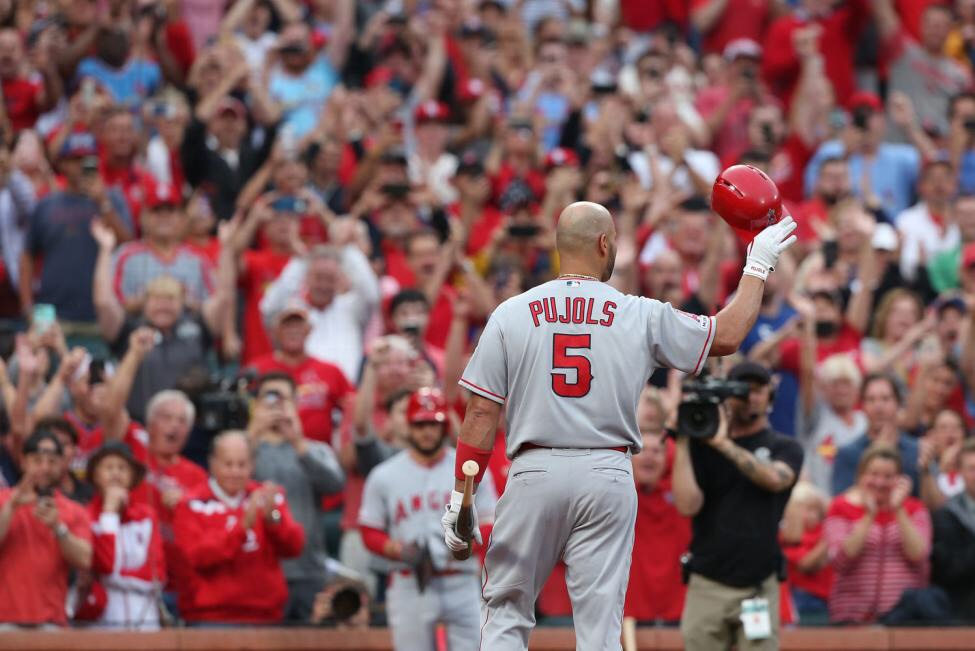
This weekend, Pujols returned to St. Louis for the first time since signing in LA. The schedule worked out so the Angels wouldn’t travel to St. Louis in the 6+ years between Pujols’ signing and now. I doubt it was intentional, but absence does make the heart grow fonder. Pujols may have received boos if he came back in 2012, like Bryce Harper did in DC this season. Sometimes, it’s just too soon. The Cardinals faithful, however, showed they have long since forgiven their old slugger with a round of standing ovations this weekend. This all grew into a crescendo when Pujols hit a home run on Saturday, his 13th this year and first in St. Louis since 2011. The Cardinals fans demanded a curtain call from Pujols… after he hit a homer against their team.
Tonight, Pujols and the Angels finish their series against the Cardinals, and Pujols is focused on helping the Angels make the playoffs. But it’s hard not to wonder what could have been. Sometimes baseball makes no sense. But sometimes it does, and for Pujols this weekend, I think baseball has made more sense than it has in a long, long time.
 Stats On Deck Blog